
How to Pronounce -ED Endings in English: /t/, /d/, and /ɪd/
Do you say “worked,” “played,” and “wanted” the same way? Many English learners add an extra syllable to every -ed word, but that is not correct.
In this lesson, you will learn the three regular past tense -ed sounds: /t/, /d/, and /ɪd/.
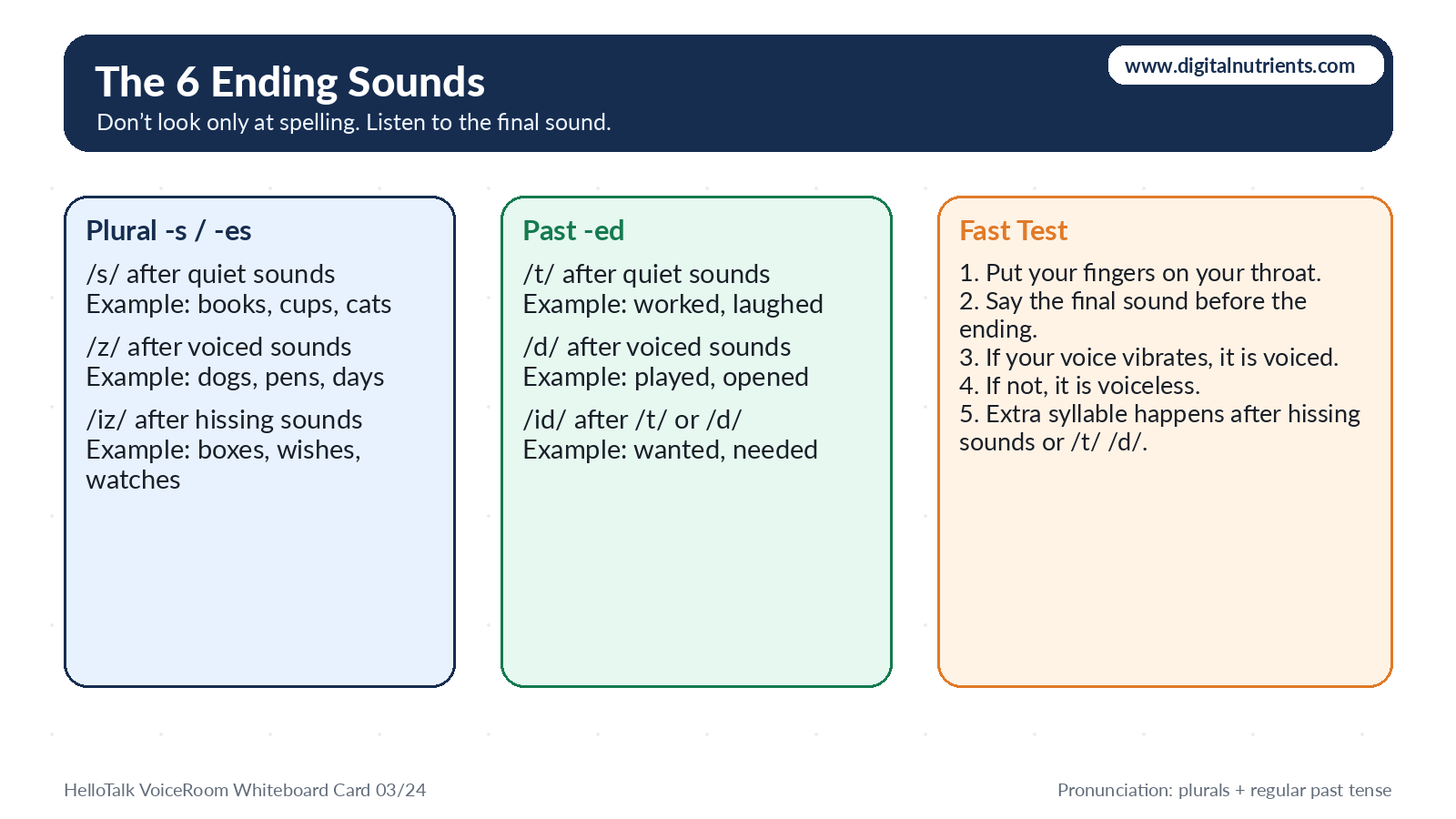
The most important rule is this:
Do not look only at the spelling. Listen to the final sound before -ed.
Regular past tense -ed can sound like /t/, /d/, or /ɪd/.
The 3 Pronunciation Rules for -ED
| Ending Sound | Use It After | Examples |
|---|---|---|
| /t/ | Quiet / voiceless sounds | worked, helped, laughed, watched |
| /d/ | Voiced sounds and vowels | played, opened, cleaned, called |
| /ɪd/ | /t/ or /d/ sounds | wanted, needed, started, decided |
Simple memory rule:
Quiet sound = /t/
Vibrating sound = /d/
Final /t/ or /d/ sound = /ɪd/
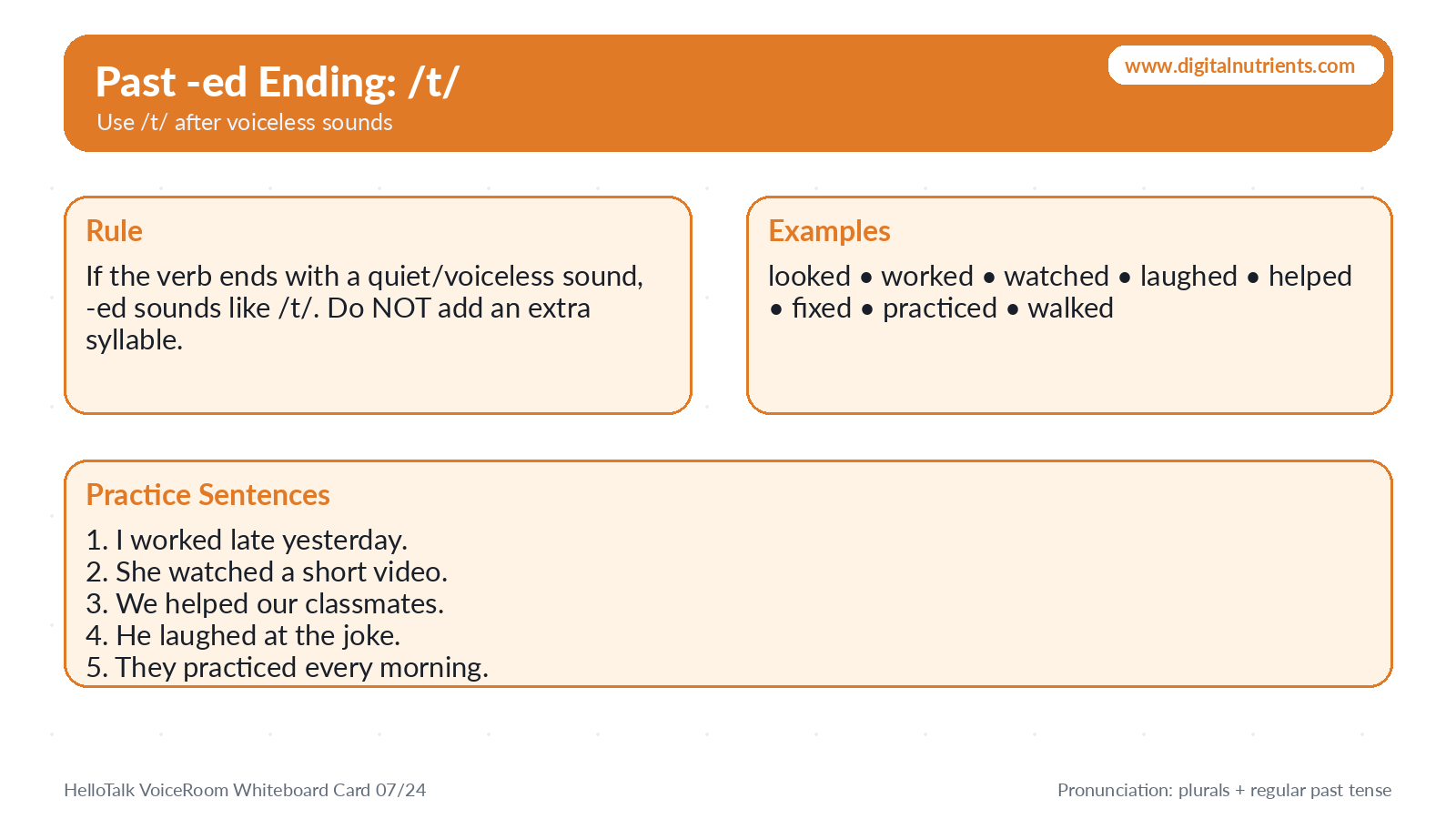
Rule 1: Use /t/ After Quiet Sounds
Use /t/ when the final sound before -ed is quiet or voiceless. Your throat does not vibrate.
Common quiet final sounds include:
/p/, /k/, /f/, /s/, /sh/, /ch/, /x/
Examples:
work → worked
help → helped
laugh → laughed
watch → watched
miss → missed
wash → washed
Practice these sentences slowly:
1. I worked late yesterday.
2. She helped her friend.
3. He laughed at the joke.
4. We watched an English video.
5. They missed the bus.
Do not say “work-ed” with an extra syllable. Say worked like one syllable: /wɜrkt/.
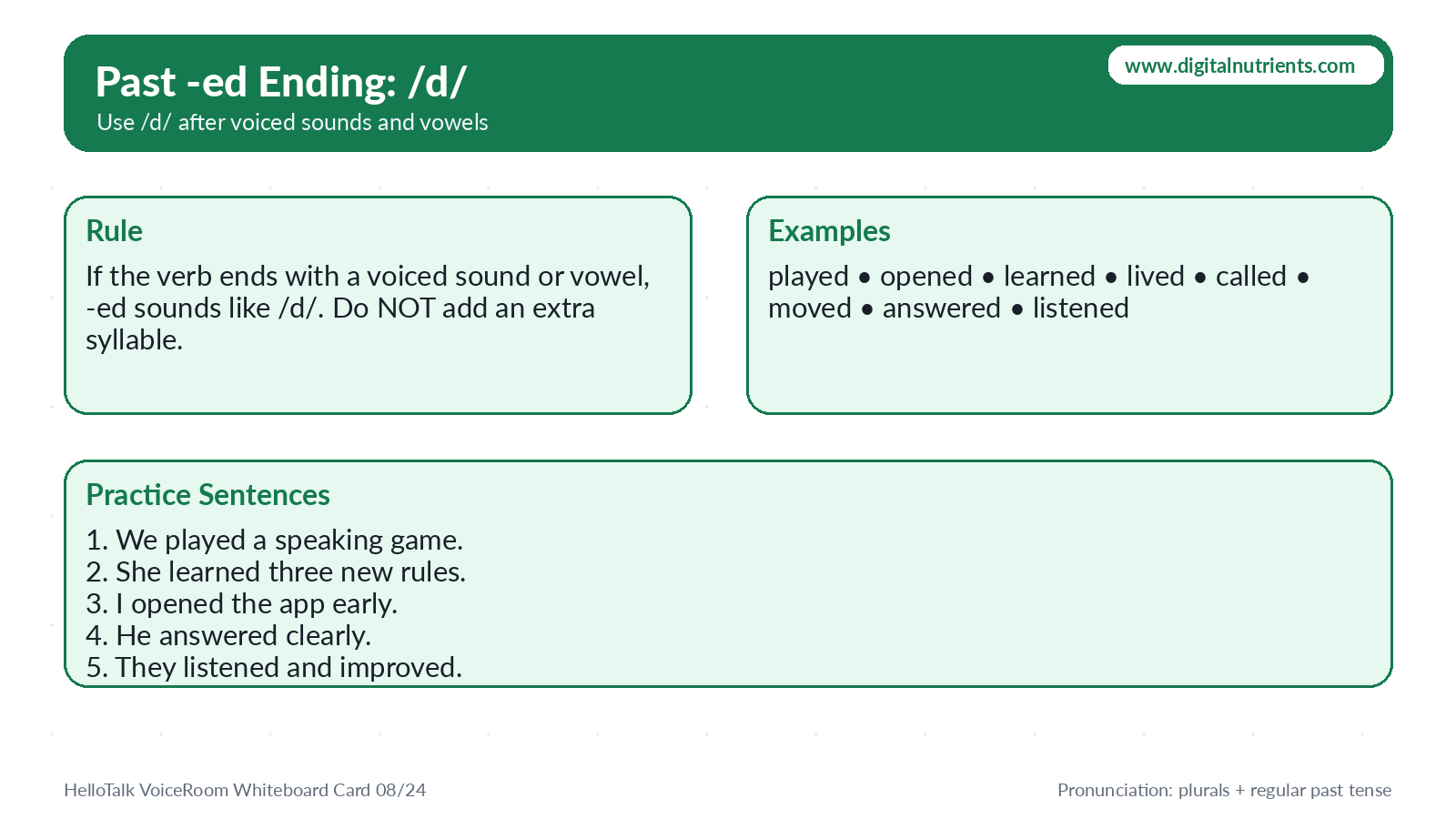
Rule 2: Use /d/ After Voiced Sounds and Vowels
Use /d/ when the final sound before -ed is voiced. This means your throat vibrates.
You also use /d/ after vowel sounds.
Examples:
play → played
open → opened
clean → cleaned
call → called
love → loved
use → used
Practice these sentences:
1. I played soccer yesterday.
2. She opened the door.
3. He cleaned his room.
4. We called our teacher.
5. They loved the lesson.
Do not say “play-ed” with an extra syllable. Say played like one syllable: /pleɪd/.
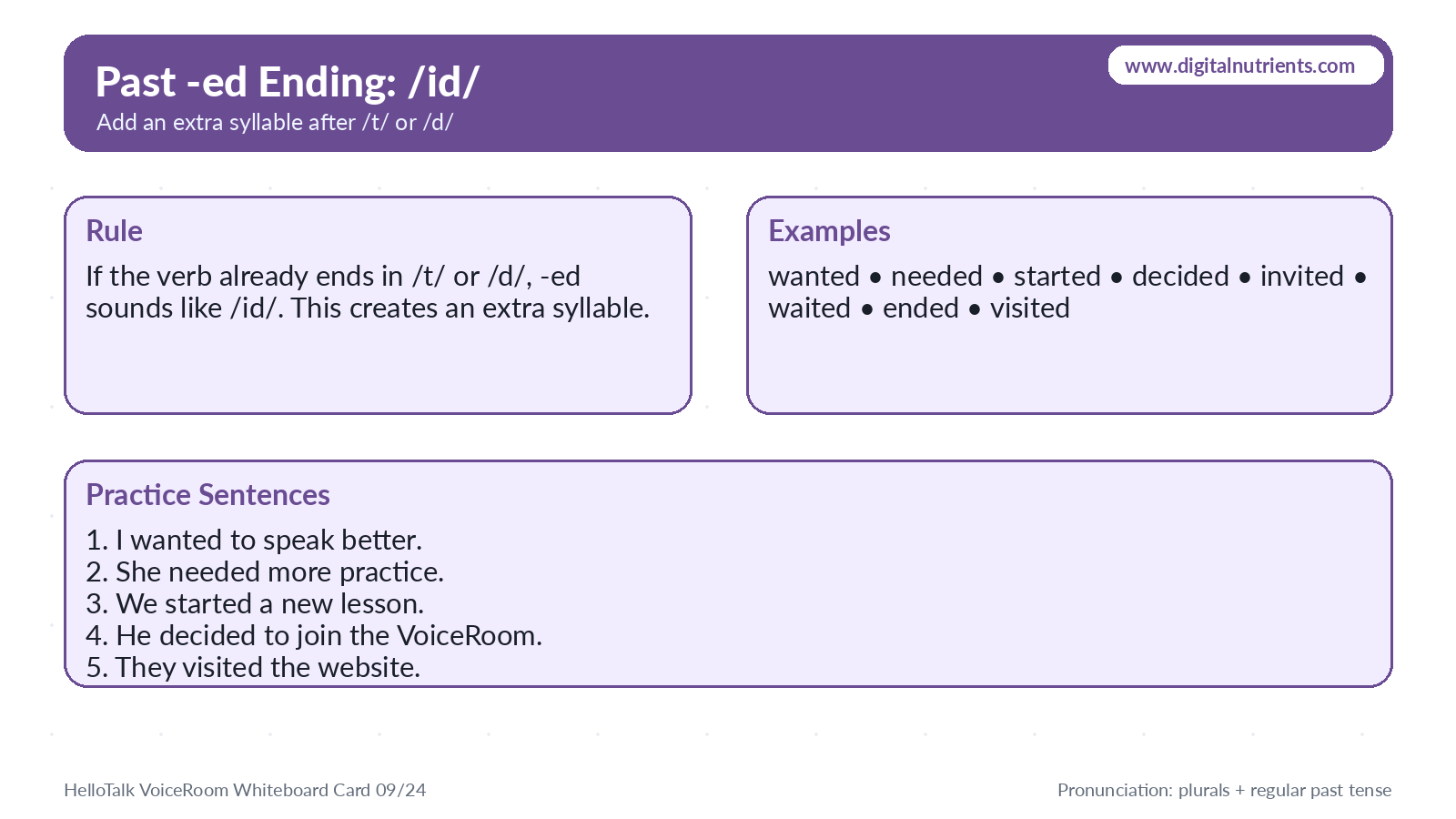
Rule 3: Use /ɪd/ After /t/ or /d/
Use /ɪd/ when the verb already ends with a /t/ or /d/ sound.
This is the only regular -ed ending that adds an extra syllable.
Examples:
want → wanted
need → needed
start → started
decide → decided
visit → visited
wait → waited
The /ɪd/ sound is short. It sounds like “id,” not a long “eed.”
Practice these sentences:
1. I wanted more practice.
2. She needed help with grammar.
3. He started a new lesson.
4. We decided to study English.
5. They visited their family.
The Fast Test: Put Your Fingers on Your Throat
Put your fingers gently on your throat.
Say the final sound before -ed.
If your voice does not vibrate, use /t/.
If your voice vibrates, use /d/.
If the word ends with /t/ or /d/, use /ɪd/ and add one extra syllable.
Common Mistakes English Learners Make
Mistake 1: Adding an extra syllable to every -ed verb.
Wrong: work-ed
Correct: worked /t/
Mistake 2: Saying every -ed ending as /d/.
Wrong: watched /d/
Correct: watched /t/
Mistake 3: Thinking the spelling tells you the sound.
The spelling is always -ed, but the pronunciation changes.
Only add an extra syllable when the verb ends with /t/ or /d/.
worked = one syllable
played = one syllable
wanted = two syllables
needed = two syllables
Mini Quiz: Choose /t/, /d/, or /ɪd/
Choose the correct -ed sound:
1. worked
2. played
3. wanted
4. helped
5. opened
6. needed
7. laughed
8. cleaned
9. watched
10. decided
Answers:
1. worked = /t/
2. played = /d/
3. wanted = /ɪd/
4. helped = /t/
5. opened = /d/
6. needed = /ɪd/
7. laughed = /t/
8. cleaned = /d/
9. watched = /t/
10. decided = /ɪd/
Speaking Practice: Read Aloud
Read each sentence three times.
First time: slowly.
Second time: normal speed.
Third time: natural English speed.
1. I worked hard and finished my homework.
2. She played music and cleaned her room.
3. He wanted help, so he called his teacher.
4. We watched a video and practiced speaking.
5. They visited family and opened gifts.
6. The students needed more time.
Homework
Write 15 regular past tense verbs with -ed endings.
Put them into three groups:
Group 1: /t/
Group 2: /d/
Group 3: /ɪd/
Then write 5 sentences using your verbs.
Record yourself reading the sentences. Listen carefully for the final -ed sounds.
Want a Clear English Study Plan?
If you feel stuck between A2 and B1, do not study random lessons only. Take the free English level test and download the A2-to-B2 roadmap so you know what to study next.