
English Punctuation for A2-B2 Learners
Do your English sentences feel confusing, too long, or difficult to read? Many English learners know the words, but their writing becomes unclear because of missing punctuation.
In this lesson, you will learn how to use periods, commas, question marks, apostrophes, and quotation marks to make your English writing clearer.
Why Punctuation Matters in English
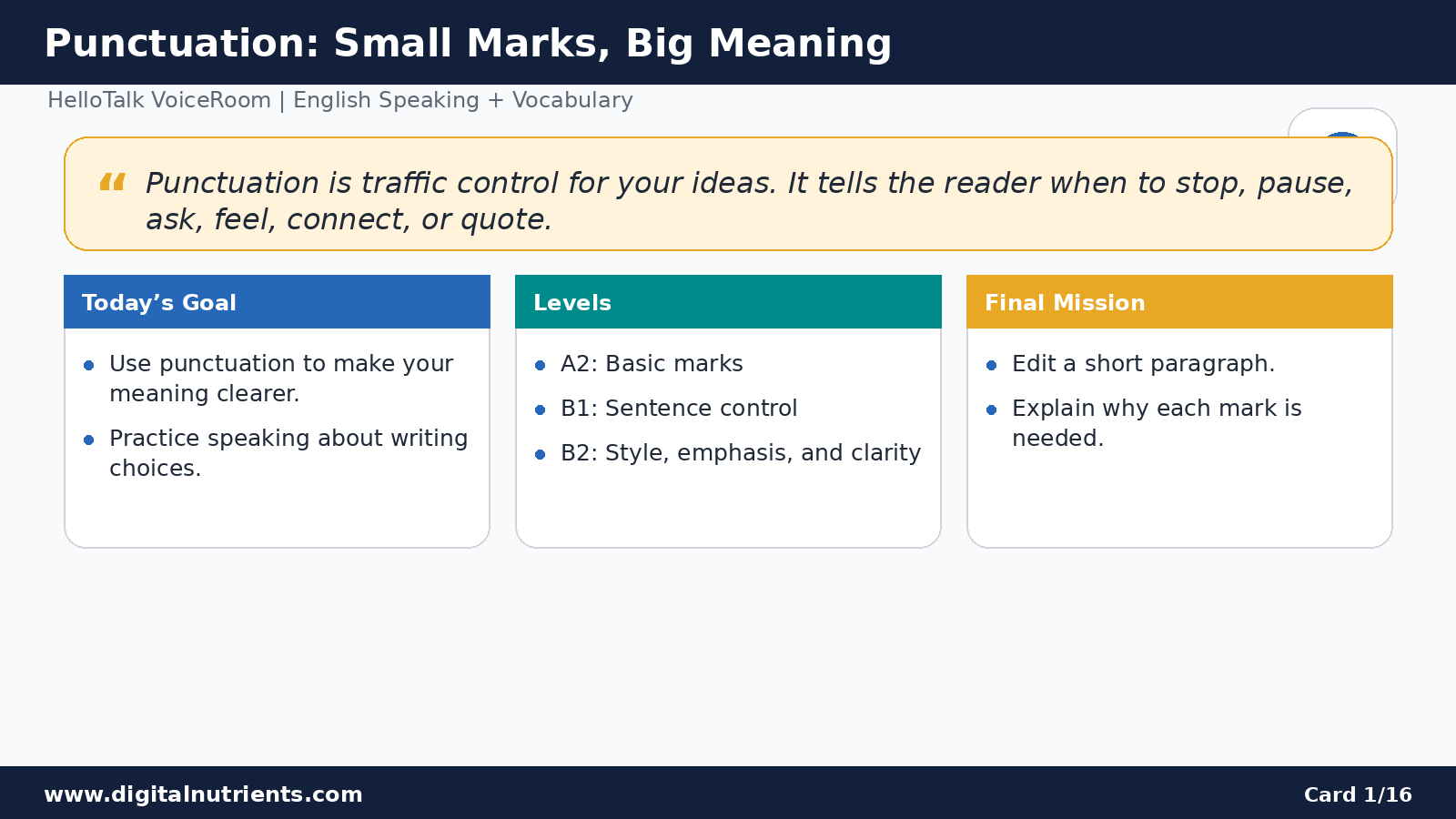
Punctuation is not decoration. Punctuation helps the reader understand where one idea ends and another idea begins.
Without punctuation, your writing can feel rushed, confusing, or unfinished.
Good punctuation helps you:
1. Separate ideas clearly.
2. Show questions.
3. Show pauses.
4. Avoid run-on sentences.
5. Make your writing look more professional.
Important rule:
Punctuation controls meaning.
A sentence without punctuation is like speaking without breathing.
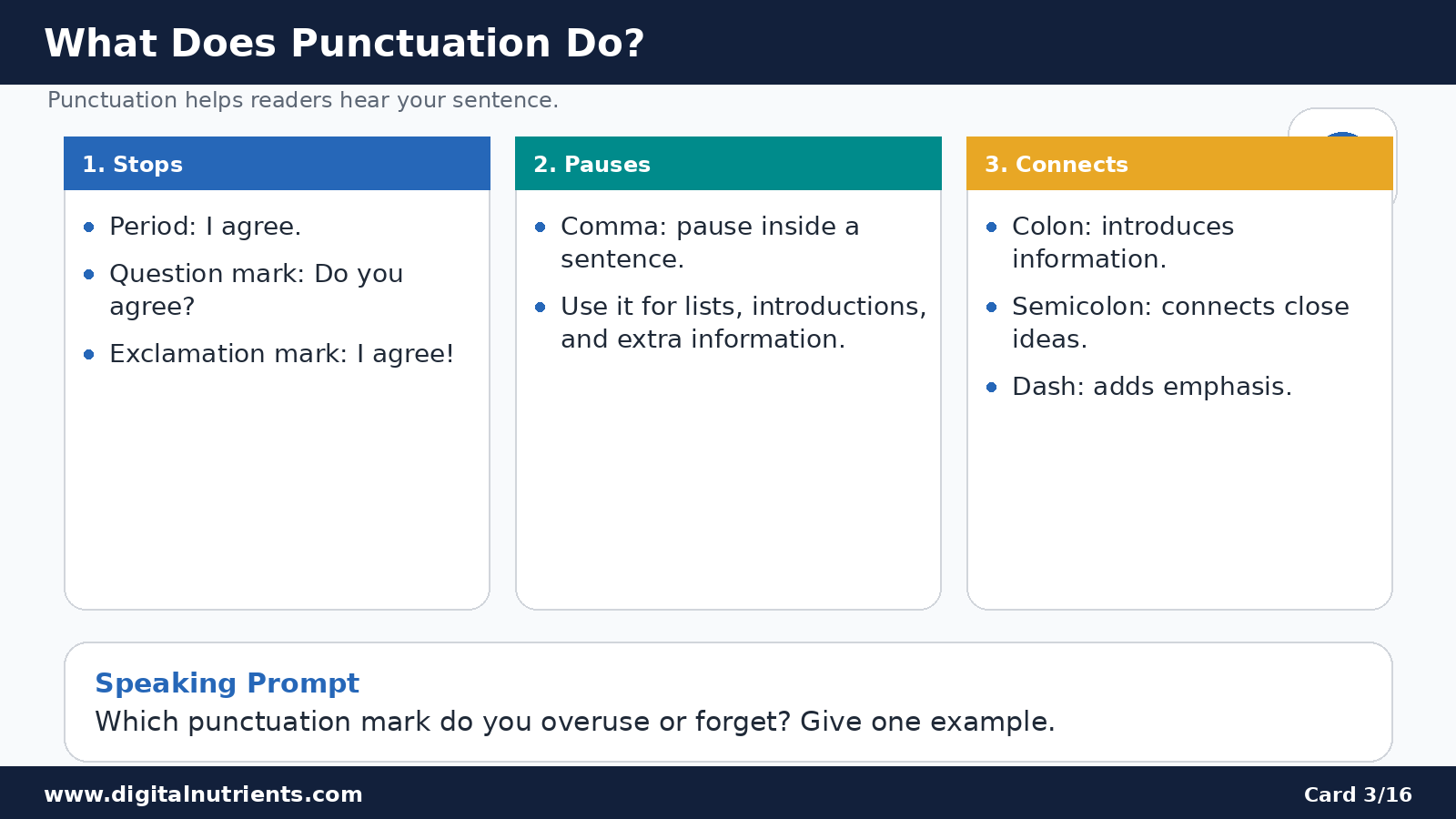
The Main English Punctuation Marks
| Punctuation Mark | Name | Main Job | Example |
|---|---|---|---|
| . | Period | Ends a statement | I study English every day. |
| ? | Question mark | Ends a question | Do you study English every day? |
| ! | Exclamation mark | Shows strong feeling | That was amazing! |
| , | Comma | Shows a pause or separates ideas | After class, I practiced speaking. |
| ' | Apostrophe | Shows contraction or possession | She’s my teacher. Cameron’s lesson is helpful. |
| “ ” | Quotation marks | Show exact speech or quoted words | She said, “I need more practice.” |
A2 learners should master periods, question marks, and basic commas first.
B1 learners should focus on commas, apostrophes, and sentence control.
B2 learners should learn how punctuation improves style, clarity, and flow.
1. Use a Period to End a Complete Statement
A period ends a complete sentence.
A complete sentence usually has a subject, a verb, and a complete idea.
Examples
I study English.
She works online.
They practice speaking every week.
My teacher explains grammar clearly.
Common Mistake
Wrong:
I study English every day I want to speak better
Correct:
I study English every day. I want to speak better.
Practice
Add periods to this paragraph:
I want to improve my English I practice speaking every day I also write short paragraphs My goal is to become more confident
Answer:
I want to improve my English. I practice speaking every day. I also write short paragraphs. My goal is to become more confident.
2. Use a Question Mark After a Direct Question
Use a question mark when you ask a direct question.
What is your English goal?
Do you practice speaking every day?
Why do you want to improve your writing?
How can I make this sentence clearer?
Common Mistake
Wrong:
Where do you live.
Correct:
Where do you live?
Important Note
Do not use a question mark after an indirect question.
Direct question:
Where do you live?
Indirect question:
She asked me where I live.
3. Use Exclamation Marks Carefully
An exclamation mark shows strong emotion, excitement, surprise, or urgency.
Use it carefully. Too many exclamation marks can make your writing look childish or unprofessional.
Examples
Great job!
That was exciting!
Be careful!
Better Writing Tip
Weak:
I am very happy!!!!
Better:
I am very happy!
4. Use a Comma After an Introductory Word or Phrase
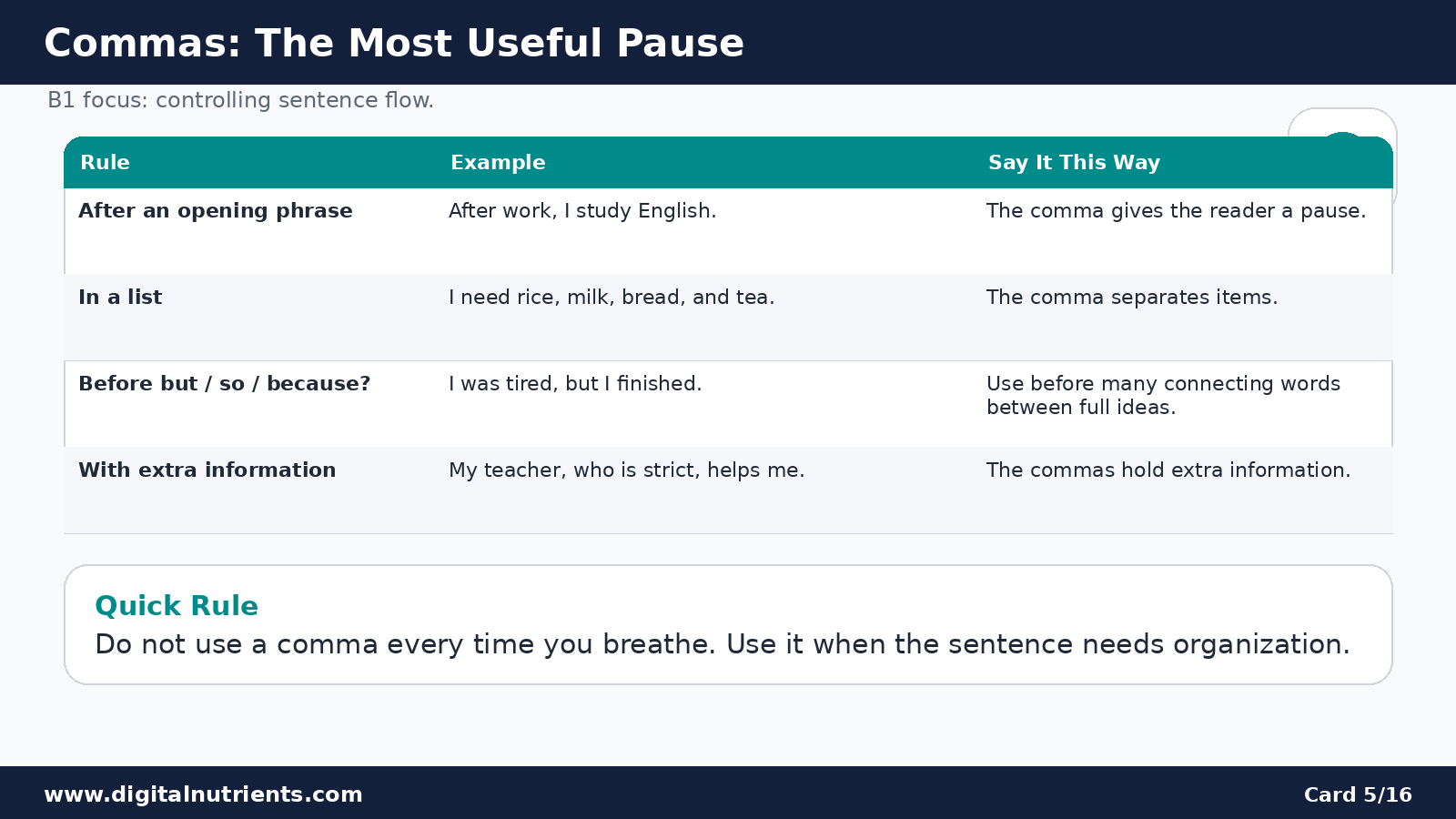
Use a comma after a beginning phrase that introduces the main sentence.
Examples
After class, I practiced speaking.
In my opinion, English is important.
Every morning, I review new vocabulary.
Because I want a better job, I study English every day.
Important Rule
When “because” starts the sentence, use a comma after the first idea.
Because I was tired, I rested.
When “because” comes in the middle, you usually do not need a comma.
I rested because I was tired.
5. Use Commas in Lists
Use commas to separate three or more items in a list.
Examples
I need to improve my grammar, pronunciation, and vocabulary.
She studies English, French, and Arabic.
We practiced speaking, listening, reading, and writing.
Common Mistake
Wrong:
I need grammar pronunciation and vocabulary.
Correct:
I need grammar, pronunciation, and vocabulary.
6. Use a Comma Before Some Connectors
When you join two complete sentences with a connector like and, but, or so, use a comma before the connector.
Examples
I study English every day, and I practice speaking at night.
She understands grammar, but she needs more speaking practice.
He made a mistake, so he corrected it.
Important Warning
Do not use commas just to make a sentence longer.
A comma is not strong enough to join two complete sentences alone.
Common Mistake
Wrong:
I study English every day, I want to speak better.
Correct:
I study English every day. I want to speak better.
Also correct:
I study English every day because I want to speak better.
7. Use Apostrophes for Contractions and Possession
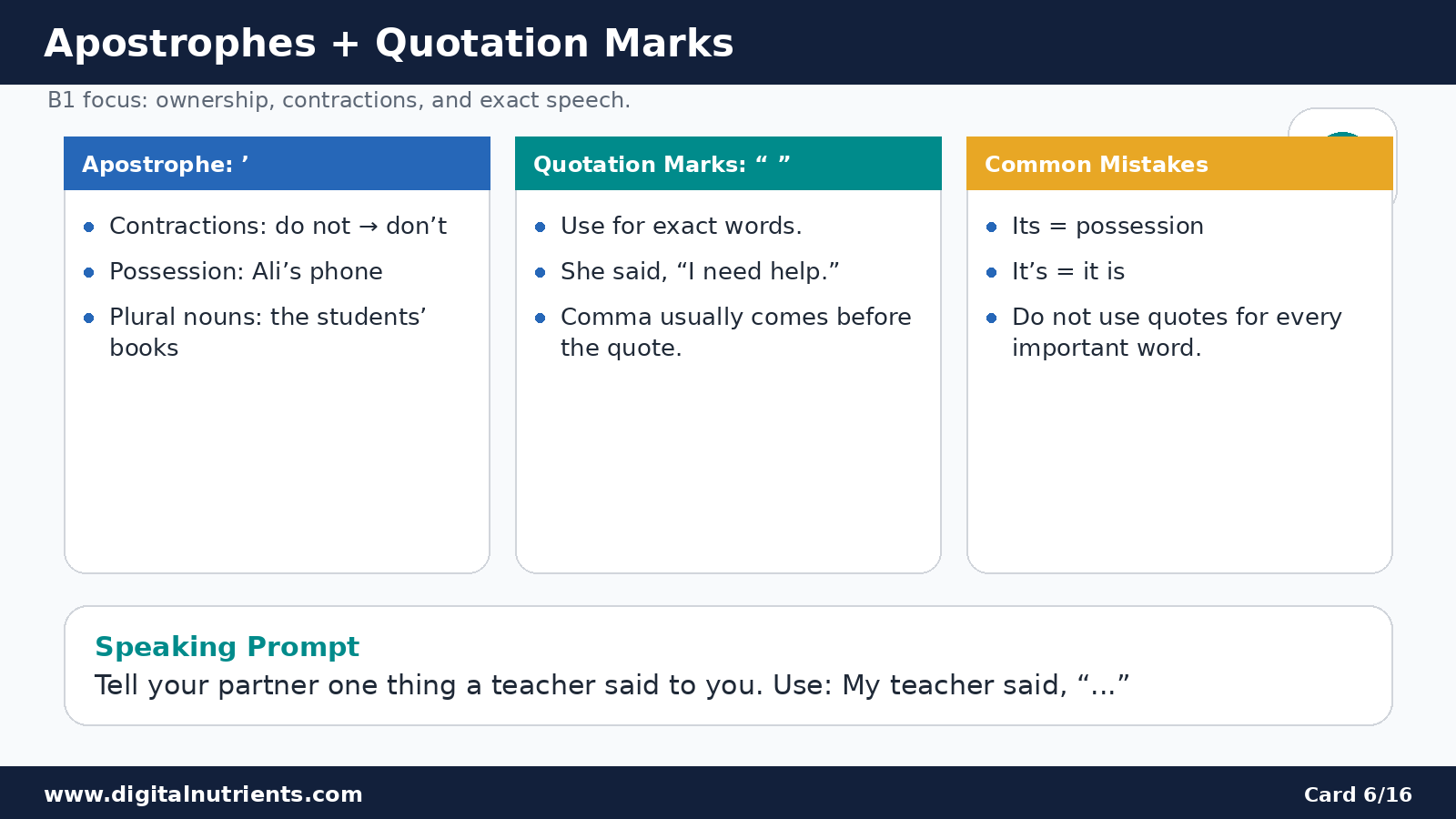
An apostrophe has two common jobs:
1. It shows missing letters in contractions.
2. It shows possession.
Contractions
I am → I’m
you are → you’re
she is → she’s
do not → don’t
cannot → can’t
will not → won’t
Possession
Cameron’s lesson is helpful.
My teacher’s advice helped me.
The student’s notebook is on the table.
Common Mistake
Its = possession
The dog moved its tail.
It’s = it is
It’s a good lesson.
8. Use Quotation Marks for Exact Words
Quotation marks show the exact words someone said or wrote.
Examples
She said, “I want to improve my English.”
My teacher asked, “What is your main goal?”
He wrote, “Practice every day.”
Common Mistake
Wrong:
She said, I need more practice.
Correct:
She said, “I need more practice.”
The Biggest Problem: Run-On Sentences
A run-on sentence happens when you put too many ideas together without correct punctuation.
Many English learners do this because they want to explain everything in one sentence.
Clear writing often needs shorter sentences.
Bad Example
I want to improve my English because I need it for work and I watch videos and I join VoiceRooms and I make mistakes but I still try because I want to be fluent.
Better Version
I want to improve my English because I need it for work. I watch videos and join VoiceRooms. I make mistakes, but I still try because I want to become fluent.
Explanation
The better version separates the ideas into clear sentences. It is easier to read and easier to understand.
What Should A2, B1, and B2 Learners Focus On?
A2 learners should focus on:
Periods
Question marks
Capital letters
Short complete sentences
B1 learners should focus on:
Commas in lists
Commas with connectors
Apostrophes
Avoiding run-on sentences
B2 learners should focus on:
Complex sentences
Commas after introductory phrases
Quotation marks
Sentence rhythm and clarity
Important Note
You do not need advanced punctuation to write well.
You need clear punctuation used correctly.
Common Punctuation Mistakes English Learners Make
Mistake 1: Forgetting periods.
Wrong:
I study English every day I want to speak better
Correct:
I study English every day. I want to speak better.
Mistake 2: Using commas instead of periods.
Wrong:
I was tired, I went home.
Correct:
I was tired, so I went home.
Also correct:
I was tired. I went home.
Mistake 3: Forgetting question marks.
Wrong:
Why are you learning English.
Correct:
Why are you learning English?
Mistake 4: Confusing its and it’s.
Wrong:
Its important to practice.
Correct:
It’s important to practice.
Practice 1: Add the Correct Punctuation
Add periods, question marks, commas, or apostrophes where needed.
1. what is your English goal
2. I study grammar pronunciation and vocabulary
3. I was tired so I took a break
4. its important to practice every day
5. after class I reviewed my notes
6. she said I need more speaking practice
Answers:
1. What is your English goal?
2. I study grammar, pronunciation, and vocabulary.
3. I was tired, so I took a break.
4. It’s important to practice every day.
5. After class, I reviewed my notes.
6. She said, “I need more speaking practice.”
Practice 2: Fix the Long Sentence
Rewrite this long sentence into two or three clear sentences.
Bad Sentence
I want to improve my English and I watch videos every day and I join VoiceRooms but I still feel nervous when I speak because many people speak faster than me
Possible Better Answer
I want to improve my English, so I watch videos every day and join VoiceRooms. I still feel nervous when I speak because many people speak faster than me. However, I keep practicing.
Practice 3: Choose the Better Sentence
1A. I need grammar vocabulary and speaking practice.
1B. I need grammar, vocabulary, and speaking practice.
2A. Why do you study English.
2B. Why do you study English?
3A. I was nervous, I spoke anyway.
3B. I was nervous, but I spoke anyway.
4A. Its difficult to speak fast.
4B. It’s difficult to speak fast.
5A. After work I study English.
5B. After work, I study English.
Answers:
1B. I need grammar, vocabulary, and speaking practice.
2B. Why do you study English?
3B. I was nervous, but I spoke anyway.
4B. It’s difficult to speak fast.
5B. After work, I study English.
Speaking and Writing Practice
Answer these questions in complete sentences. Use correct punctuation.
1. Why are you learning English?
2. What is difficult for you in English?
3. How do you practice speaking?
4. What grammar rule do you want to improve?
5. What is your English goal this month?
I am learning English because ______. I practice by ______, but I still need help with ______.
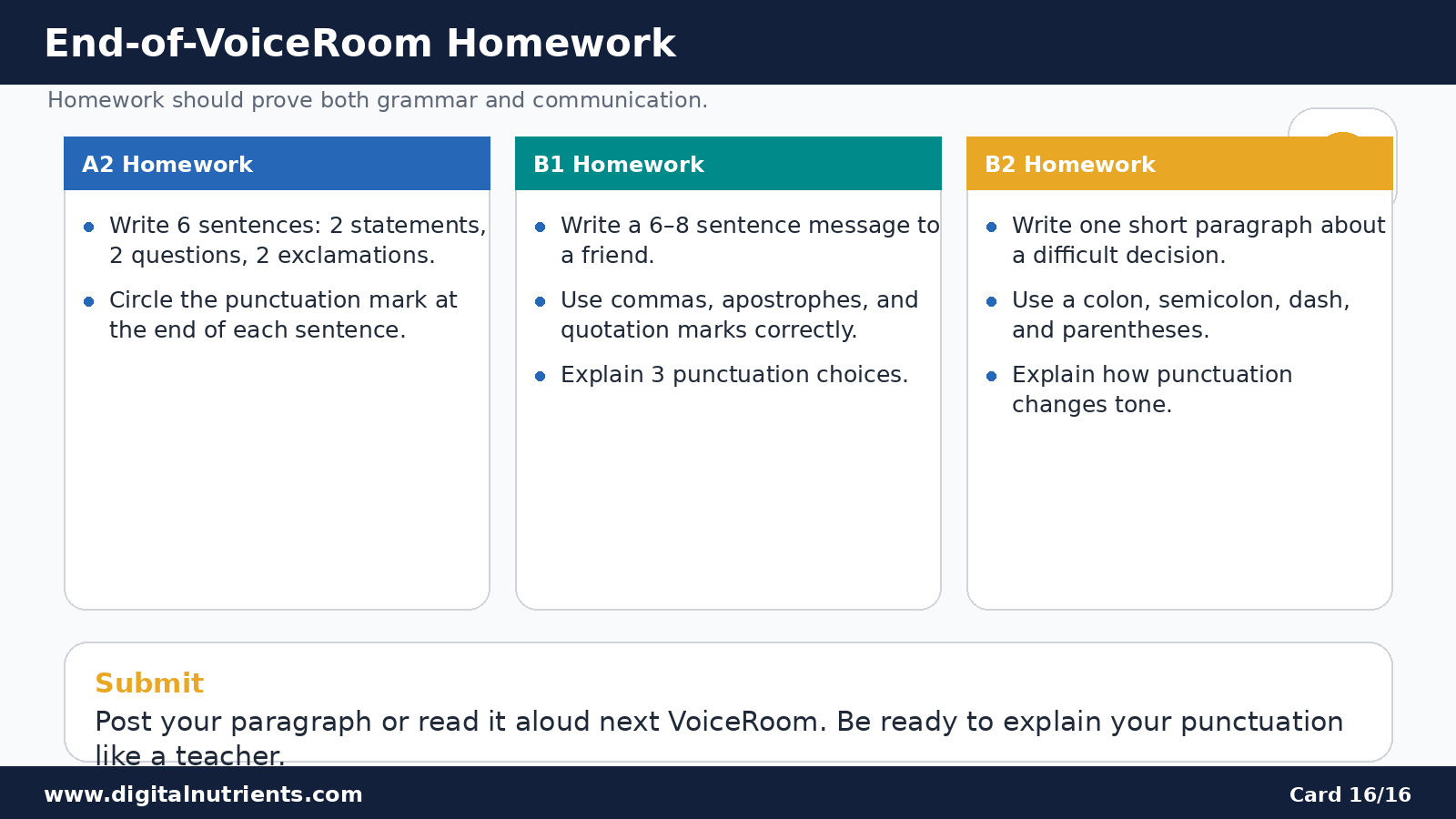
Homework
Write one short paragraph about this topic:
Why do I want to improve my English?
Your paragraph must include:
1. At least four complete sentences.
2. At least one comma.
3. At least one connector, such as because, but, or so.
4. Correct periods.
5. No run-on sentences.
After you write, check your paragraph:
Did every sentence start with a capital letter?
Did every sentence end with punctuation?
Did I use commas correctly?
Did I avoid making one sentence too long?
Did I check it’s and its?
Want a Clear English Study Plan?
If you feel stuck between A2 and B1, do not study random lessons only. Take the free English level test and download the A2-to-B2 roadmap so you know what to study next.